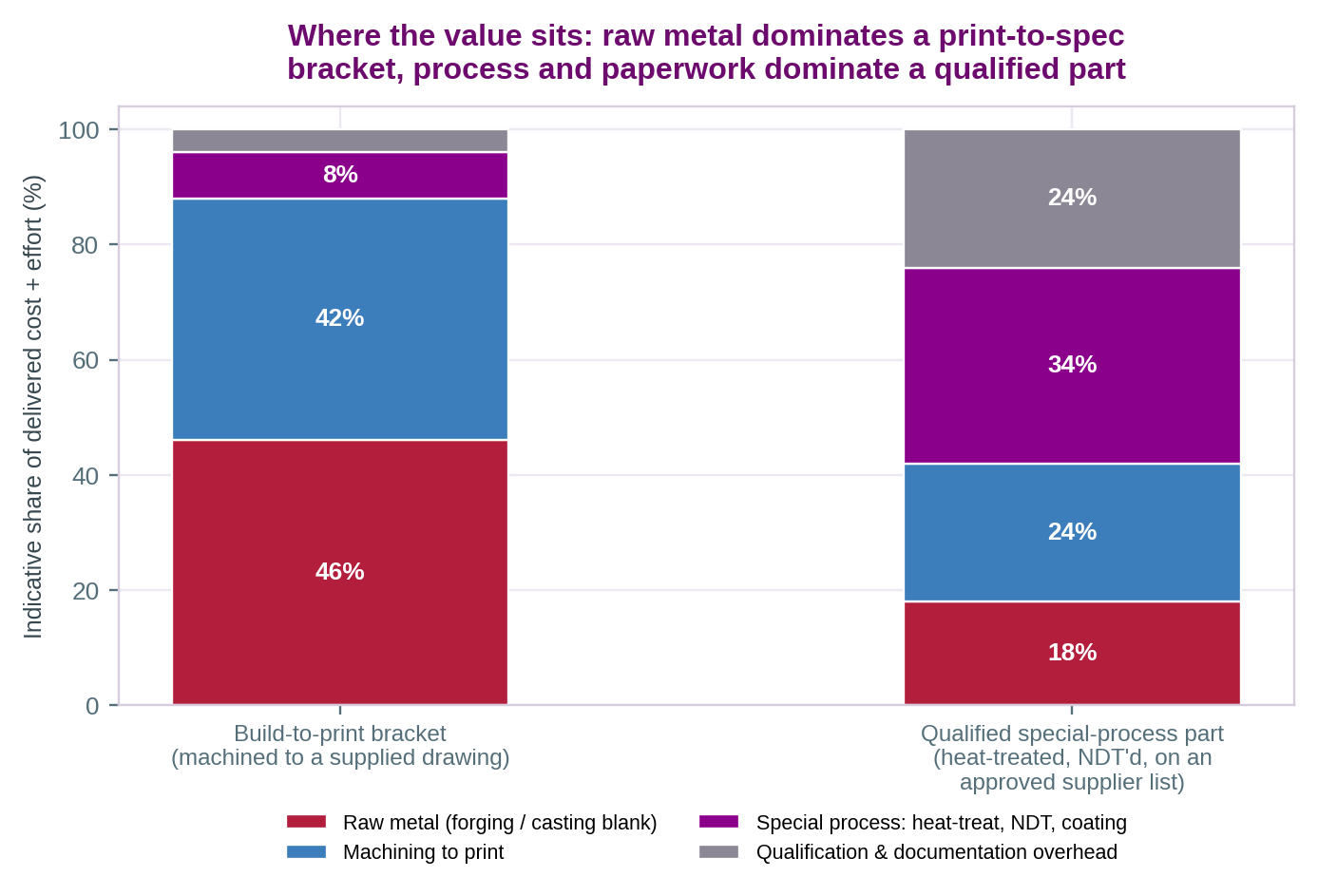
Three reasons the hard half does not scale the way the easy half does.
A machined bracket's success criterion is a measurement you take today. A special process's success criterion is the absence of a failure that would only show up after years of service — a fatigue crack, a corrosion pit, a bond-line disband. You cannot inspect your way to confidence here; you can only control the process tightly enough, and document that control thoroughly enough, that a customer trusts the absence of visible defects as a proxy for the presence of invisible strength.
Nadcap accreditation is not a one-time badge. It is renewed on a one-to-three-year audit cycle, and a First Article Inspection has to be repeated after a design change, a process change, a tooling change, a change of manufacturing location, or a break in production of two years or more. A capability, once built, has to be maintained continuously — there is no equivalent of "the machine still cuts the same shape it did five years ago" for a special process; the audit trail has to prove it, every cycle.
Qualifying a new supplier on a new part means the OEM or Tier-1 itself absorbs the cost of auditing, running first-article inspections, and often destructively testing early production units. Having paid that cost once, an OEM has every incentive not to pay it again for a marginal price improvement from a second source — which is exactly why, once a supplier is on the Approved Supplier List for a given part, switching becomes structurally difficult, independent of whether a patent exists (there usually isn't one).